The New York Times’s Op-Docs and the National Film Board of Canada (NFB) have debuted their immersive, interactive multimedia series, A Short History of the Highrise yesterday.
Optimised for tablet and comprised of videos on urban highrise living, the series had its world premiere at the New York Film Festival and launched yesterday on NYTimes.com.
Incase you weren’t aware already, the series unfolds in four short, interactive films that viewers can navigate using touch commands like swipe, pinch, pull and tap. It includes an incredible array of archive photographs, brought to life with intricate animation, game play and touch-responsive videos that create exploratory experiences. The films are narrated by the Canadian musicians Feist and Cold Specks, as well as by Katerina Cizek, documentary filmmaker and HIGHRISE director, who wrote and directed the films.
i-Docs
torsdag 17. oktober 2013

fredag 20. september 2013
HTML5 is the Future of Book Authorship
I expect that the coming year will bring continued growth and innovation in the sphere of HTML5-based software tools for publishers. In June of 2013, the W3C launched the Digital Publishing Interest Group with the goal of bringing together publishing veterans to work on bridging the gap between the needs of book/journal/magazine publishers and the technological capabilities afforded by W3C specifications.
At O’Reilly Media, as we work on transitioning to an XHTML5-source* workflow (which will be the cornerstone of the next release of our Atlas publishing platform),** we have posted an open source project on GitHub calledHTMLBook. The HTMLBook project contains an XML Schema that subsets the HTML5 content model to provide specifications for book-specific semantics, such as chapters, appendixes, and sidebars. Additionally, it contains a sample CSS stylesheet for styling HTML5 content for PDF output using CSS3 Paged Media, andXSL tools for autogenerating book navigation elements including tables of contents, indexes, and cross-references, as well as generating the necessary metadata and package files for EPUB 3 output. We look forward to continued collaboration around the development of HTML5 authoring tools for publishers.
O'Reilly Media
søndag 18. august 2013
An end of books
We're entering a new golden age for books, one with more books and ebooks being written and read today than ever before. No, books won’t be completely eliminated, just as vinyl records are still around (a new vinyl store is opening in my little town). But please don’t hold your breath for any element of the treasured ecosystem to return in force.
Is it traitorous to my tribe to write these words? I'm not arguing that we should push the ecosystem out the door, but I am encouraging us to not spend too much time trying to save it. First, it's a losing battle, but more important, we have bigger opportunities right in front of us.
Twenty years ago, I saw the web and wrote it off. I said it was a cheap imitation of Prodigy, but slower and with no business model. Partly, I just didn't see. But a big part of me wanted Prodigy (my client) to succeed, along with a business model I understood. As a result of my arrogance, I missed the opportunity to take advantage of a brand new medium.
torsdag 15. august 2013
Være eller å ikke være for bokbransjen
Norges tre største forlag, Cappelen Damm, Gyldendal Norske forlag og Aschehoug, har i løpet av det siste året brukt rundt 100 millioner kroner på utvikling av nye digitale plattformer og løsninger.
– Vi satser nå digitalt på alle fronter. Vi mener at dette er å være eller å ikke være i denne bransjen. Det digitale bokmarkedet vil vokse i årene som kommer, men vi er fortsatt bak USA og England, sier informasjonssjef Bjarne Buset i Gyldendal Norsk Forlag.
– Ebokmarkedet har så langt vært fokusert mot romaner og barnebøker som apper, og det jobbes med å utvikle formater som håndterer alle typer av bøker, sier Forlagsdirektør på netthandel og digitale produkter Øisten Wahl i Cappelen Damm. Han tror 2014 vil bli et gjennombruddsår for de mer kompliserte bøkene for lesing på nettbrett, mobil eller PC.
Kilde: DN.no via Nettbrett & ebøker
tirsdag 30. juli 2013
Quartz turn everyone into a graphics editor
Quartz creates visualizations — charts, mostly — of data so quickly off the news cycle. The answer involved an in-house tool that made it relatively simple to turn a data set into a chart that fit Quartz’ visual aesthetic.
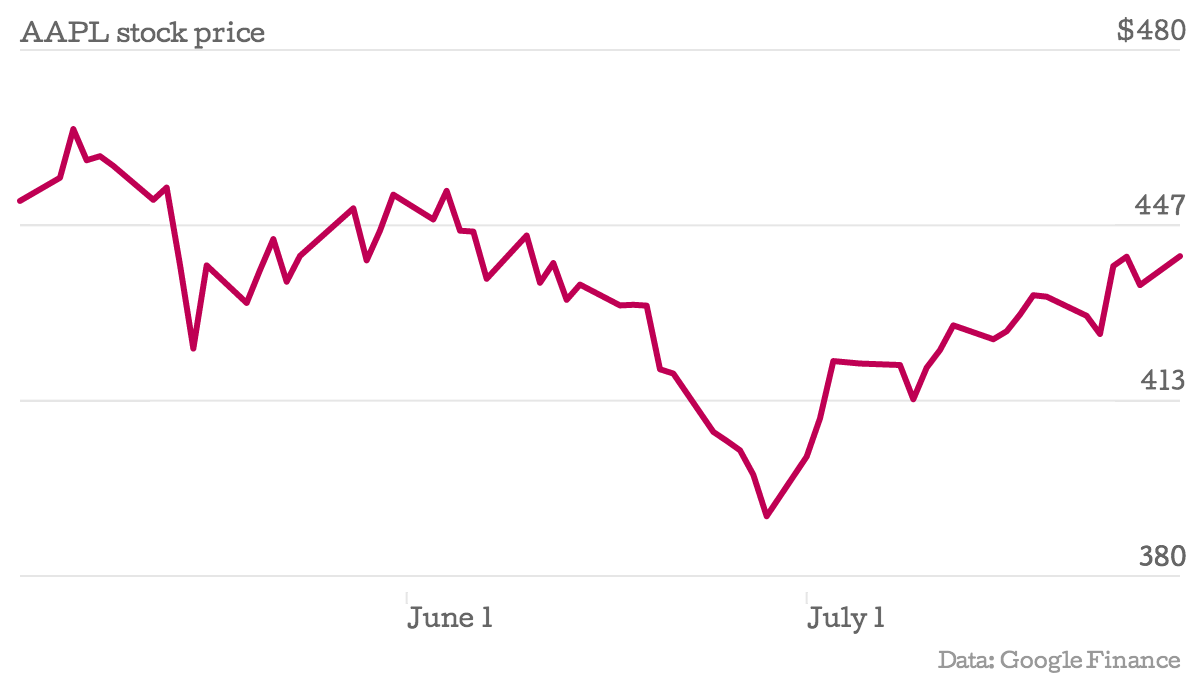
I was very happy, when tweeting with that tool’s creator, David Yanofsky, to learn that Quartz planned on open-sourcing the tool. It’s built on the amazing D3.js — built by The New York Times’ Mike Bostock — which is immensely powerful but also features a learning curve that’s proven a bit too steep for me. Today, that tool, Chartbuilder, is available for your use. (Here’s a chart of Apple’s stock price since May 3 that I made in about three minutes.)
Nieman Journalism Lab
I was very happy, when tweeting with that tool’s creator, David Yanofsky, to learn that Quartz planned on open-sourcing the tool. It’s built on the amazing D3.js — built by The New York Times’ Mike Bostock — which is immensely powerful but also features a learning curve that’s proven a bit too steep for me. Today, that tool, Chartbuilder, is available for your use. (Here’s a chart of Apple’s stock price since May 3 that I made in about three minutes.)
Nieman Journalism Lab
torsdag 18. juli 2013
Augmented Reality Bring Drawing To Life
ColAR (iOS/Android) is “the coloring book of the future.”:
First, you go to colAR’s web site and print out your coloring page of choice (the free app usually comes with one option included and a few others available for in-app purchase, but their full catalog is free until July 28th)… Once you’re done [coloring], pop open the app, and hit the “Play” button to bring up a camera view. Hold your drawing up to the camera, and bam! It takes your work of art and wraps it around an animated 3D model.
TechCrunch
tirsdag 2. juli 2013
Six digital publishing startups to watch
You know you can blog with Tumblr or WordPress, or self-publish a book on Kindle or iBooks. But what’s next for the publisher who wants to sell a mobile-native magazine, or the blogger who’s sick of messing with plugins?
Here are six startups that offer new options to creators. Three of them — Periodical, 29th Street Publishing and Creatavist — let you create and sell mobile-friendly magazines, ebooks and newsletters; the other three — Postach.io, Ghost and Glipho — aim to let you blog in a new way.
paidContent
Here are six startups that offer new options to creators. Three of them — Periodical, 29th Street Publishing and Creatavist — let you create and sell mobile-friendly magazines, ebooks and newsletters; the other three — Postach.io, Ghost and Glipho — aim to let you blog in a new way.
paidContent
Subcompact Publishing
There is an intuitive usability implicit to the physicality of our printed books and magazines. A reader is given two possible directions — which one depends on language and culture. And from there, a mostly linear, usually obvious interface.4
Tablet and smartphone books and magazines are not so obvious. They’re so not obvious that we often need tutorials explaining just how to use them.
Why did we jump to such complex interfaces?
Craig Mod
Tablet and smartphone books and magazines are not so obvious. They’re so not obvious that we often need tutorials explaining just how to use them.
Why did we jump to such complex interfaces?
Craig Mod
torsdag 27. juni 2013
Books in the Age of the iPad
As the publishing industry wobbles and Kindle sales jump, book romanticists cry themselves to sleep. But really, what are we shedding tears over?
We’re losing the throwaway paperback.
The airport paperback.
The beachside paperback.
We’re losing the dregs of the publishing world: disposable books. The book printed without consideration of form or sustainability or longevity. The book produced to be consumed once and then tossed. The book you bin when you’re moving and you need to clean out the closet.
These are the first books to go. And I say it again, good riddance.
mandag 17. juni 2013
– Dette er som Netflix for barnebøker
Det var en gang slik at mange småbarnsforeldre fikk det for seg at det kunne være spennende, morsomt eller til og med lærerikt for barna å få leke seg med et nettbrett. Etter langt om lenge, og lengre enn langt (alt er relativt), hadde også utvalget av apper til barna begynt å bli rikt og mangfoldig.
En av de mange aktørene som lager apper til barn er Propell, et heldigitalt barnebokforlag. De har foreløpig har satset mest på iPhone- og iPad-apper, men som også tilbyr noen få barnebøker til Android-plattformen.
Nå nylig har det norske forlaget lansert en tjeneste som de selv omtaler som "Netflix for barnebøker". Tanken er altså at du betaler en fast månedssum for å tilgang til alle barnebøkene, og at det skal komme nye titler hver uke. Vi har sjekket om du får valuta for pengene.
Kilde: Amobil.no via Nettbrett & ebøker
Abonner på:
Innlegg (Atom)